
The 10 Best Free Scheduling Apps in 2026 (Tested)
Updated October 27, 2026

At a glance
We tested the free plans of 10 scheduling apps, and zcal's gave us the most: no cap on booking links or calendars, plus meeting polls, group events and an automatic email reminder, with no ads.
That matters, because most "free" scheduling apps aren't free for long. You get one booking link, or one calendar, or no reminders, and the first time you need a second kind of meeting, the app asks for a credit card. To find out where each one stops, we used every free plan the way a freelancer or a small business would, until it asked us to upgrade.
Below you'll find what each free plan really includes, where it stops, what the first paid plan costs, and who each app suits best.
Table of contents
The best free scheduling apps at a glance
| App | Best for | What the free plan includes | Where the free plan stops | First paid plan |
|---|---|---|---|---|
| zcal | Most people | Unlimited booking links and calendars, meeting polls, group events, email reminders | Group events up to 5 people per time slot. Round robin and SMS reminders need Pro | $7 per user a month |
| Cal.com | One person who wants detailed workflows | Unlimited event types and calendars, reminder workflows, paid bookings | 1 user. No meeting polls. Cal.com branding stays | $12 per user a month |
| Google Calendar | One simple booking page | 1 booking page with buffer time and booking questions | 1 calendar. No automatic reminders or payments | Google One Premium or Google Workspace |
| Calendly | One kind of meeting | 1 event type, 1 calendar, meeting polls, video links | No reminders, group events or payments | $10 per seat a month |
| Setmore | A small team that books from a business page | Up to 4 users, unlimited appointments, 1 email reminder, payments | Can't connect Google or Microsoft calendars. No SMS reminders | $5 per user a month |
| Square Appointments | In-person businesses that use Square | Booking site, reminders, unlimited staff calendars | A card fee on every payment. No-show fees and a waitlist need Plus | $49 a month per location |
| Zoho Bookings | Solo users on Zoho apps | 1 event type, 1 calendar, up to 3 reminders | 1 user, 1 event type. No payments | $6 per user a month |
| SimplyBook.me | Service businesses with few bookings | 50 bookings a month, booking website, email reminders | 1 provider. Payments need a paid plan | $11.90 a month |
| YouCanBook.me | Hosts who approve each booking | 1 booking page, 1 calendar, Stripe payments, booking approval | No reminders. A "Powered by YouCanBookMe" bar | $8.10 a month |
| Doodle | An occasional group poll | 1 group poll, 1 booking page, 1 one-on-one link | Ads. No reminders | $11 a month |
Paid prices are billed yearly. Monthly billing costs more, and each app below lists both.
What is a scheduling app?
A scheduling app lets people book time with you without the back-and-forth. You set the hours you're free and share a booking link, and people pick a time that works for them. The app checks your calendar, adds the meeting to it, and sends everyone the details.
The good ones do more of the work for you. They add a Zoom, Google Meet or Microsoft Teams link to each booking, remind your guests before the meeting so fewer of them forget, and take payment when someone books. Some also run group polls, so a whole team can find one time that suits everyone.
Which kind of scheduling app do you need?
"Scheduling app" covers a few different jobs. Pick the kind that matches yours first, then compare the apps that do it.
- Booking links for meetings and appointments. You share a link, and people book a time with you. zcal, Calendly, Cal.com, Google Calendar, YouCanBook.me and Zoho Bookings all started here.
- Booking sites for service businesses. A menu of services with prices, your staff and your opening hours, like a salon or a massage studio would show. Square Appointments, Setmore and SimplyBook.me are built for this.
- Team scheduling. Round robin shares new meetings across a team, and collective events find a time when several hosts are all free. On every app in this list, team features are paid.
- Group polls. For one meeting with many people, you suggest a few times and everyone votes. zcal and Doodle do this, and Calendly's free plan includes polls too. Free grid sites like When2meet do only this job (here's how to use When2meet).
- Staff shift scheduling. Rotas for employees who work shifts, such as in a shop or a restaurant. That's a different kind of app, like When I Work, Connecteam or Homebase, and it isn't on this list.
How we tested
In October 2026, we used the free plan of each app the way a new user would. We set up a booking page, went through the settings, and tried what most people need sooner or later: a second kind of meeting, a second calendar, reminders, payments and group bookings. When an app stopped us, we wrote down its limit in its own words. Zoho Bookings and SimplyBook.me start every new account on a trial of their paid features, so their free-plan limits come from their own plan pages. Every price comes from the app's own plan page or its in-app plan picker.
The 10 best free scheduling apps
1. zcal: best free scheduling app overall
zcal is a free scheduling app for booking links, meeting polls and group events. You connect your Google, Outlook or Apple calendars, make a link for each kind of meeting, and people can only book the times you're free. When they do, zcal adds a Zoom, Google Meet or Microsoft Teams link to the invite and sends an email reminder before the meeting.
What sets it apart is how much the free plan does. Where most apps on this list stop you at one link or one calendar, zcal has no cap on either, and polls, group events and reminders are free too. Zapier picked zcal as the "Best free meeting scheduler" in its 2026 list of meeting scheduler apps.
It's also the best-looking booking page here. Most free pages on this list are a name, a calendar and a grid of times. A zcal booking page is built to reflect your brand, with a large cover photo, a short welcome video and a personal intro next to the calendar, so guests get a feel for who they're meeting before the call starts. It's made for phones too, where many guests book.
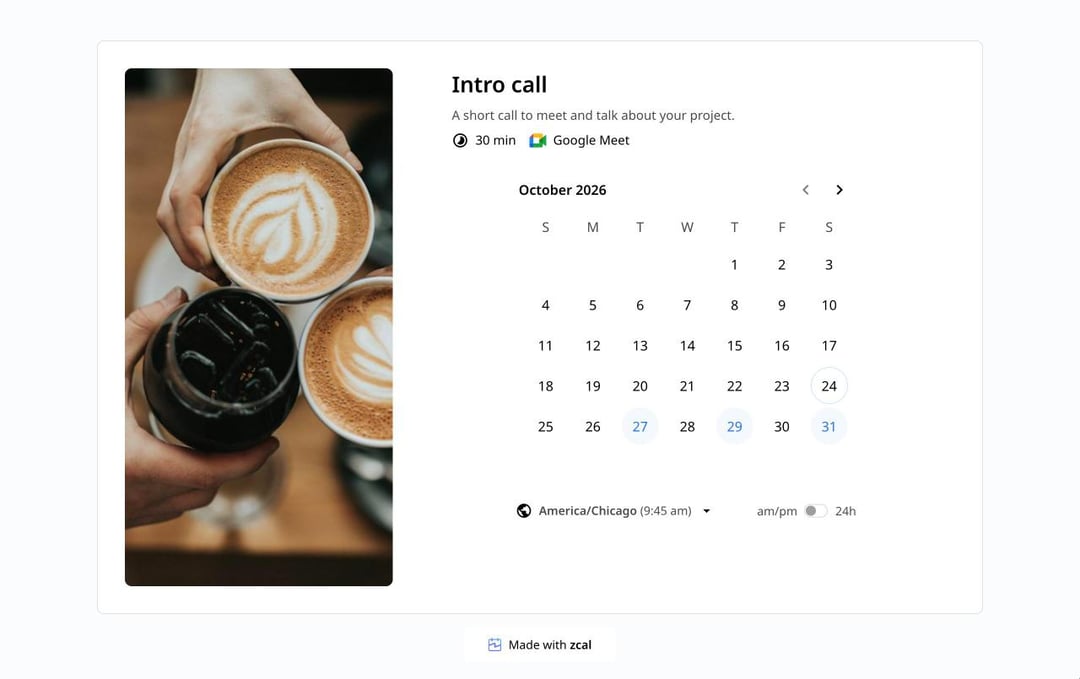
In our test: zcal was the easiest app on this list to get going. The first booking link took a few minutes: connect a calendar, pick a length, share the link. Polls were the nicest surprise. Guests tap the times they can make, and once you pick the final time, zcal sends the calendar invite to everyone, so there's nothing left to copy by hand.
What's free
- Unlimited booking links, each with its own length, location and questions. One link can also offer several lengths.
- Unlimited calendars. zcal checks every Google, Outlook and Apple calendar you connect, so you're never double-booked.
- Meeting polls and group events, with up to 5 people per time slot.
- An automatic email reminder before each meeting.
- Zoom, Google Meet and Microsoft Teams links, Stripe payments, Zapier, and an embed for your website.
- A cover photo and a welcome video on your booking page, and no ads.
Paid plans
Pro costs $7 per user a month billed yearly, or $10.50 billed monthly. It adds round robin, collective events, a team page, SMS reminders, more email reminders, follow-up emails, and the option to remove zcal's branding. Business costs $12 per user a month billed yearly, or $18 monthly, and adds more teams and your own domain.
Pros
- The most generous free plan on this list, with no cap on booking links or calendars.
- 1-on-1 links, polls and group events in one free app.
- A booking page that reflects your brand, with a cover photo and a welcome video.
- Round robin for $7 per user, less than half the price of Calendly Teams.
Cons
- Round robin and SMS reminders need Pro.
- Group events on the free plan stop at 5 people per time slot.
Choose zcal if
You want more than one booking link or calendar without paying, or you run both 1-on-1 calls and group sessions. It's also an easy step up for a small team that needs round robin.
2. Cal.com: best for one person who wants detailed workflows
Cal.com looks and works much like Calendly, and it can import your Calendly event types in one click. For one person, the free plan is generous: no cap on event types or calendars, reminders you build yourself, and paid bookings with Stripe or PayPal.
The trade-off is depth. Each booking link has 13 tabs of settings, and reminders live in a visual workflow builder with branches and filters. That's a lot of power if you like to fine-tune, and a lot to learn if you just want a link to share. Unlike zcal and Calendly, Cal.com has no meeting polls, so group scheduling needs a second tool.
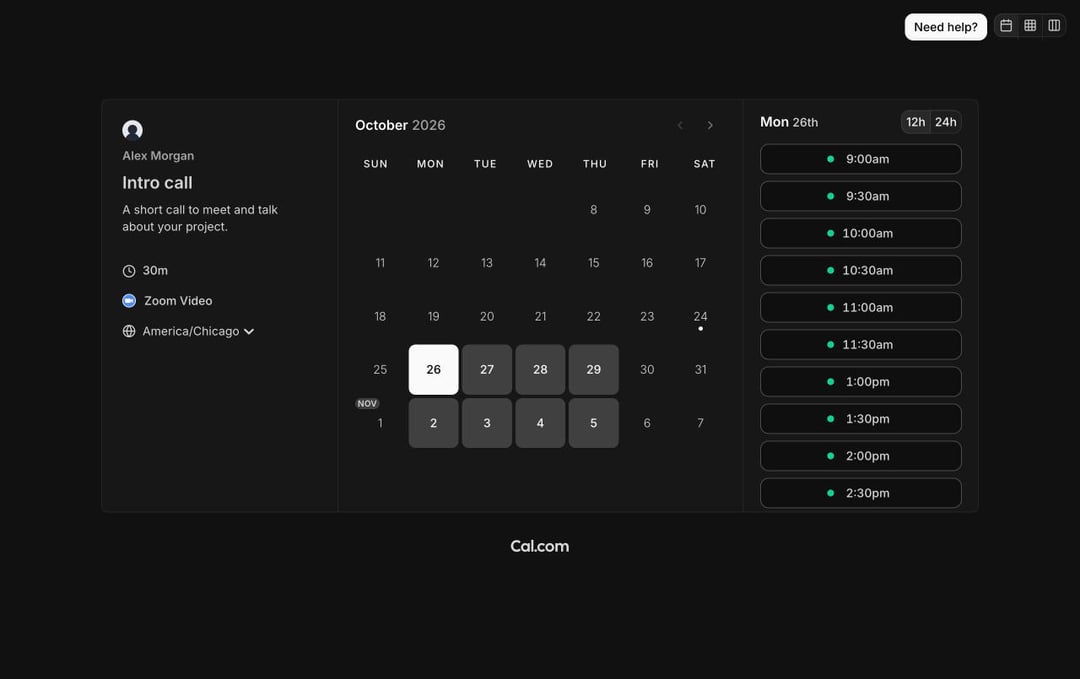
In our test: Cal.com is powerful, but it's a lot. One booking link has 13 tabs of settings, and a simple reminder email lives in a workflow builder with branches and filters, which is far more than most people need. We did like the live preview beside the settings, and guests can switch the page between a month, week or column view. Plan on spending real time learning it.
What's free
- Unlimited event types and calendars, for 1 user.
- Reminders and follow-ups by email or text, built as workflows.
- Paid bookings with Stripe or PayPal, and seats for group bookings.
- Zoom, Google Meet and 100+ other apps, plus two-way sync with Salesforce and HubSpot.
- One-click import of your Calendly event types.
Paid plans
Teams costs $12 per user a month billed yearly, or $16 billed monthly. It adds round robin, collective events, routing forms, and removes the Cal.com branding. Organization costs $28 per user a month billed yearly, or $37 monthly, and adds more teams, a company subdomain and single sign-on.
Pros
- No cap on event types or calendars for one person.
- Reminders, payments and seats are free.
- Imports from Calendly in one click.
Cons
- No meeting polls.
- The free plan is for 1 user, and team features start at $12 per user.
- 13 tabs of settings per link take time to learn.
- Cal.com branding stays on the free plan.
Choose Cal.com if
You're one person who wants to fine-tune every link and build your own reminder workflows. If you also need polls, or you'd rather set up a link in a few minutes, zcal is the easier pick.
3. Google Calendar: best for one simple booking page
If you already live in Google Calendar, appointment schedules are the easiest place to start, because there's nothing new to sign up for. You set your hours, Google turns them into a booking page, and each booking lands in your calendar with a Google Meet link.
A free Google account gets one booking page, and it checks one calendar. Automatic email reminders, more calendars and payments all need a paid Google One or Google Workspace plan. So it works well for one kind of meeting, like office hours, and stops there.
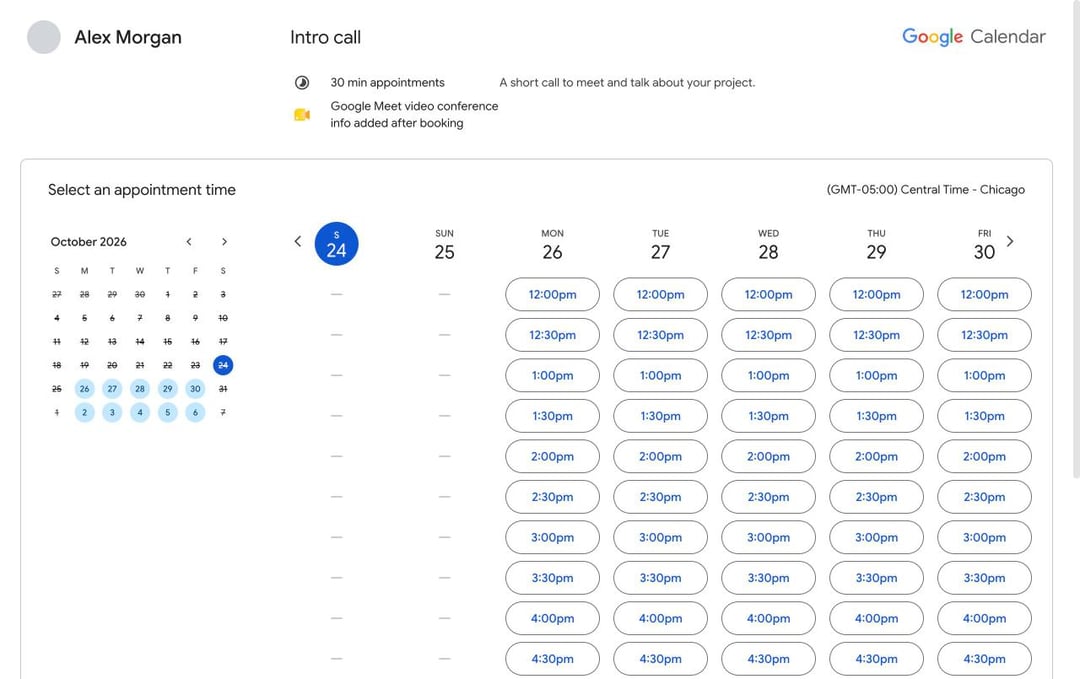
In our test: Google Calendar was the most convenient app to start with and the quickest to outgrow. While you set your hours, the open slots show up on your own week view, which is a nice touch. But the moment we looked for a second calendar or a reminder, Google asked us to "Get this and more with a Google One Premium plan." And the guest page is bare: a grey circle, your name and a grid of times.
What's free
- 1 booking page with a Google Meet link for each booking.
- Buffer time and a daily limit on bookings.
- Booking form questions beyond name and email.
- Checks 1 calendar for conflicts.
Paid plans
More booking pages, automatic email reminders, more calendars and payments need Google One Premium or an eligible Google Workspace plan. Workspace Business Starter also gets only 1 booking page.
Pros
- Nothing new to sign up for if you use Google Calendar.
- You see your bookable slots in your own calendar.
- Buffer time and daily limits are free.
Cons
- 1 booking page and 1 calendar.
- No automatic reminders on the free plan.
- A plain page with the Google Calendar logo.
Choose Google Calendar if
You need a single booking page for one kind of meeting and you spend your whole day in Google Calendar. For a second kind of meeting or a reminder, you'll need another app or a paid plan.
4. Calendly: best for one kind of meeting
Calendly is the name most people know, and that helps: your guests rarely need to be told how a Calendly link works. The free plan never expires, includes unlimited meeting polls, and adds a video link to every booking.
The catch is the word "one": 1 active event type and 1 connected calendar. There are no reminders, no group events and no payments, so most people move to Standard at $10 per seat a month. See what Calendly's free plan includes for the full list.
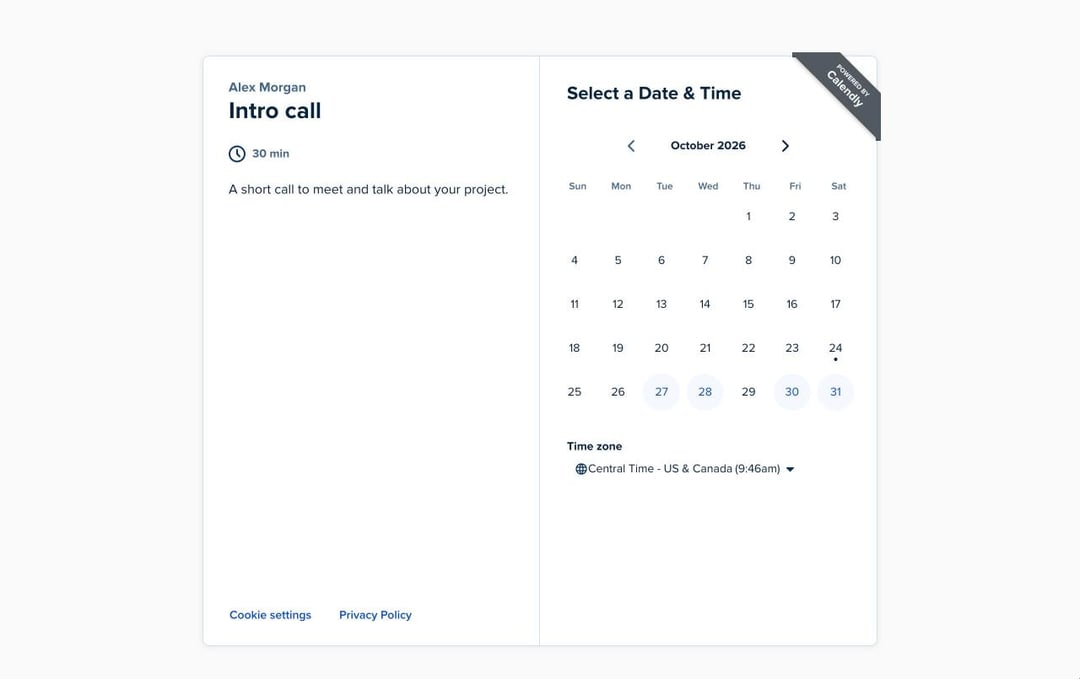
In our test: Calendly is polished, but its free plan feels like a trial that never ends. When we turned on a second event type, Calendly said: "Multiple event types are not available on your Free plan." A second calendar, a group event and removing the branding all hit the same wall, each with "Subscriptions starting at $10 per user/month". After the fourth upgrade box, it's clear the free plan is there to sell you Standard.
What's free
- 1 active event type, with no limit on bookings.
- 1 connected calendar.
- Unlimited meeting polls.
- Zoom, Google Meet and Microsoft Teams links.
- An embed, the mobile app and the browser extension.
Paid plans
Standard costs $10 per seat a month billed yearly, or $12 billed monthly. It adds unlimited event types, more calendars, reminders, payments, and group and collective events. Teams costs $16 per seat billed yearly, or $20 monthly, and adds round robin. The "Plus" plans add an AI notetaker for $8 more per seat.
Pros
- A name your guests already know.
- Meeting polls on the free plan.
- A mobile app and a browser extension.
Cons
- 1 event type and 1 calendar on the free plan.
- No reminders until Standard.
- Every paid plan is priced per seat, and round robin needs Teams at $16.
Choose Calendly if
You only ever take one kind of meeting, from one calendar, and your guests already know Calendly. Once you need more, compare the Calendly alternatives first.
5. Setmore: best for a small team that books from a business page
Setmore gives your business a booking page that looks like a small website: your services with prices and lengths, your team, your opening hours and your reviews, with a phone number to call. Up to 4 people can share the free plan, there's no cap on appointments, and clients can pay online or in person.
The catch is your calendar. On the free plan, Setmore can't connect to Google or Microsoft calendars, so it can't see the meetings that are already in yours. That's fine if Setmore is your only calendar, and risky if it isn't.
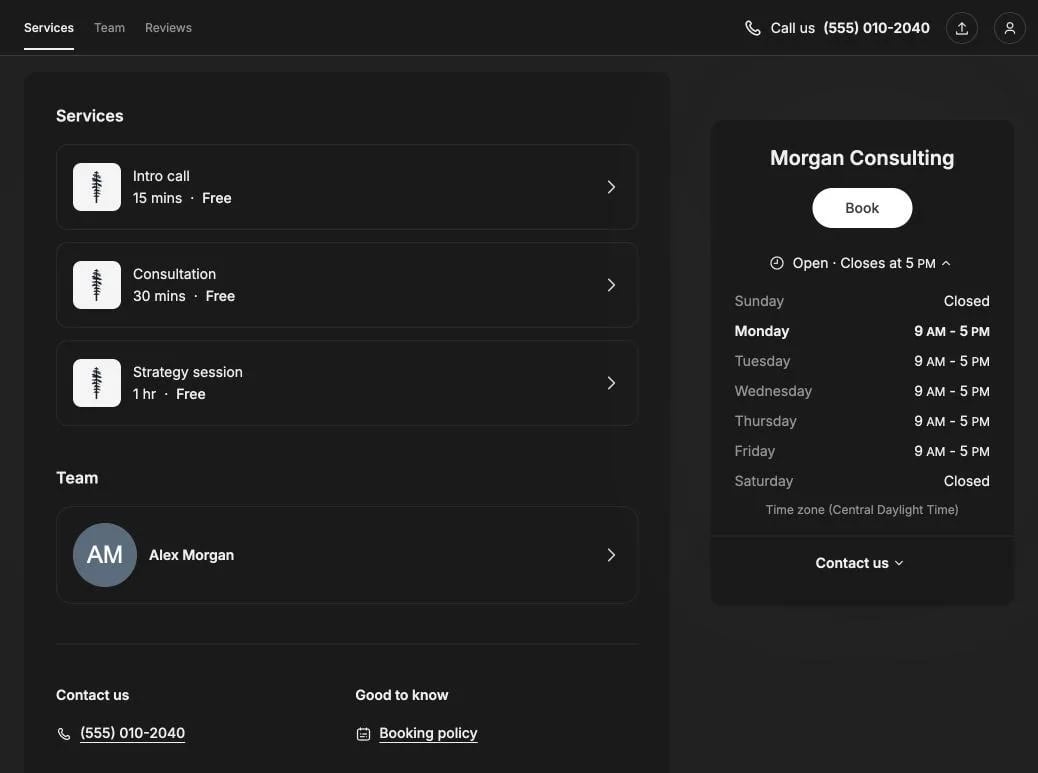
In our test: Setmore's booking page is one of the nicest on this list for a small business, with services, team, hours and reviews on one page. But for us, the calendar limit was a deal-breaker. Clicking "Connect with Google" opened the Pro upgrade box, and so did "Connect with Microsoft", so on the free plan Setmore will happily offer times you're already busy.
What's free
- Up to 4 users, with unlimited appointments.
- A business booking page with services, team, opening hours and reviews.
- Payments with Square, Stripe or PayPal.
- 1 email reminder before each appointment.
- iOS and Android apps.
Paid plans
Pro costs $5 per user a month billed yearly, or $12 billed monthly. It adds two-way calendar sync, SMS reminders, recurring appointments, video appointments, unlimited users, and removes the Setmore branding.
Pros
- Up to 4 users on the free plan.
- A booking page that looks like a small business website.
- Payments on the free plan.
Cons
- No Google or Microsoft calendar on the free plan.
- No SMS reminders or video appointments until Pro.
Choose Setmore if
You run a small studio or shop where Setmore will be your only calendar, and up to 4 people take bookings. If you also have meetings in Google or Outlook, pick an app that checks them for free.
6. Square Appointments: best for in-person businesses that use Square
Square Appointments is the booking side of Square's point-of-sale system. If your clients pay at the counter with a Square reader, it keeps bookings and payments in one place: your services and prices online, a reminder before each visit, and the card payment at the end.
The free plan is free per location, with no cap on staff calendars. Square earns its money on payments instead: 2.6% + 15¢ on each card payment in person, and 3.3% + 30¢ online. No-show fees, a cancellation policy and a waitlist need Square Plus, at $49 a month per location.
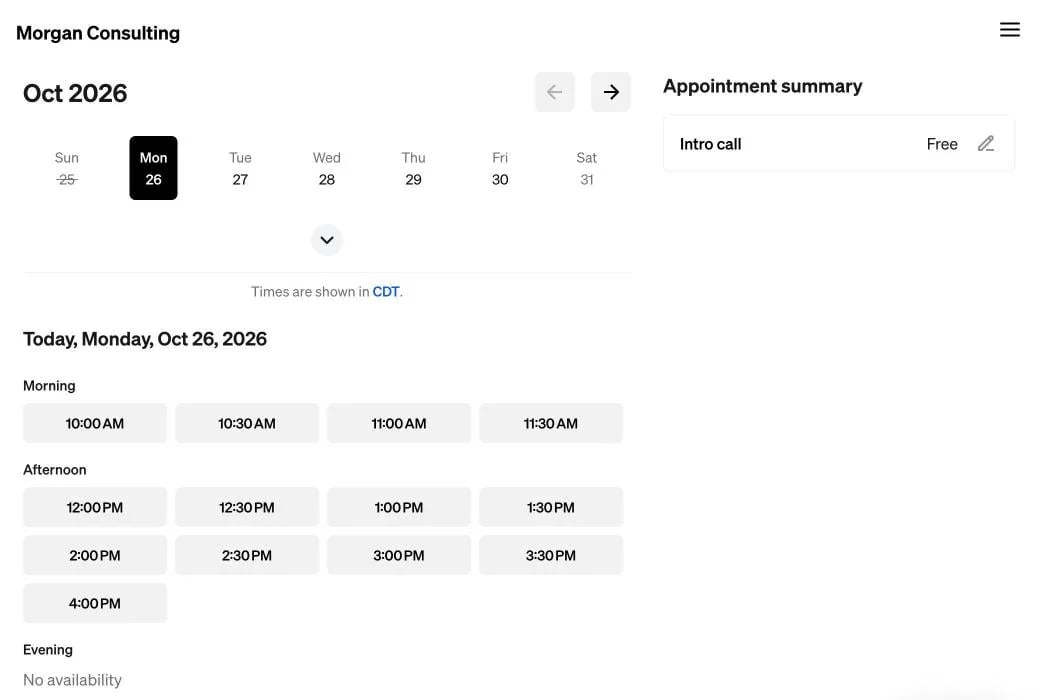
In our test: Square is built for the counter, not the calendar. Our new account opened on a point-of-sale home page full of card payment and hardware offers, and we had to dig through "Add more" just to turn on Appointments. Once it was on, though, the booking site was clean and easy to follow: pick a service, then pick a time from morning, afternoon or evening slots. Booking from an Instagram "Book" button and from Reserve with Google is a real plus for a shop.
What's free
- An online booking site and a widget for your own site.
- Appointment reminders.
- Unlimited staff calendars, and sync with Google Calendar.
- Bookings from Instagram and from Reserve with Google.
- Card payments in person and online, with a fee on each one.
Paid plans
Plus costs $49 a month per location. It adds no-show fees, a cancellation policy, multi-staff appointments, a waitlist, and a lower online card fee of 2.9% + 30¢. Premium costs $149 a month per location and adds resource management and more reports.
Pros
- Bookings and in-person payments in one place.
- Booking from Instagram and Google.
- No cap on staff calendars.
Cons
- A fee on every card payment.
- The setup starts in Square's point-of-sale dashboard, which is more than you need for meetings.
- No-show fees need Plus at $49 a month.
Choose Square Appointments if
You run a salon, barbershop or studio that already takes payments with Square. For online meetings and calls, a meeting scheduler is the simpler fit.
7. Zoho Bookings: best for solo users on Zoho apps
Zoho Bookings is the scheduling app in Zoho's suite, next to Zoho CRM and Zoho Mail. The free plan is for one person: one event type, one calendar, up to 3 reminders for you and your client, and online meeting links in the confirmation email.
One event type is the big limit. Zoho's own page tells free users to "create a single event for your primary service," so a second kind of meeting means Basic, at $6 per user a month. Payments start one plan higher, on Premium.
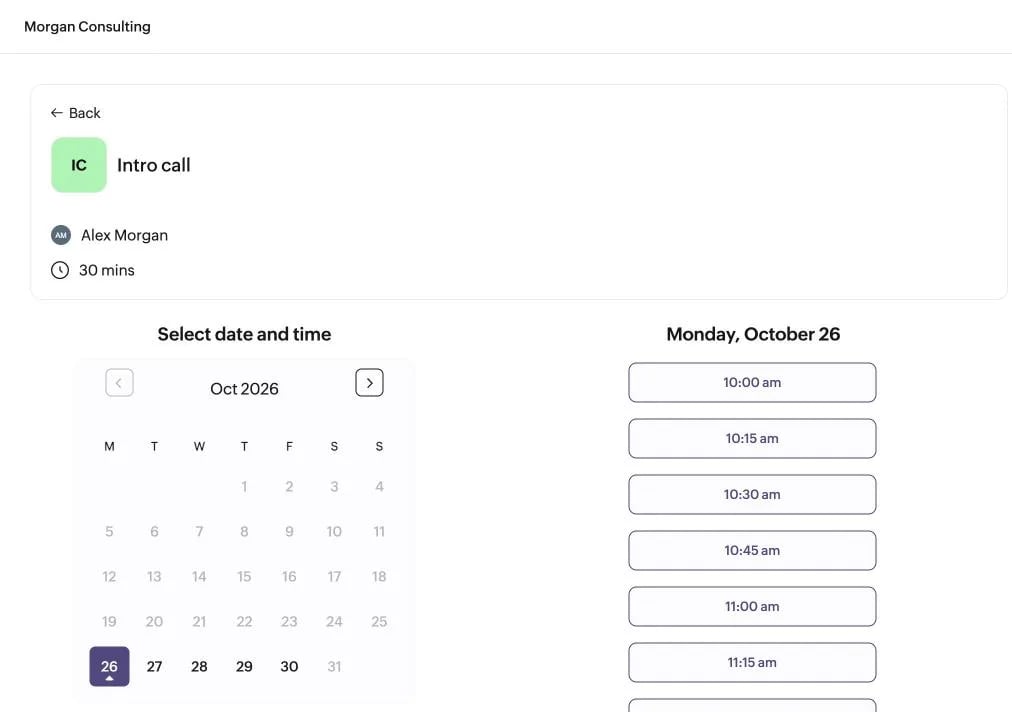
In our test: Zoho Bookings feels like a business tool squeezed into a free plan. New accounts start on a 15-day trial of the paid features, so everything works at first and the one-event limit only bites later. The booking page is plain to the point of dull, with your initials in a colored box and not much else.
What's free
- 1 user and 1 event type, with unlimited appointments.
- 1 calendar, with two-way sync to Zoho, Google or Microsoft.
- Up to 3 reminders for you and your client.
- Online meeting links in the confirmation email.
Paid plans
Basic costs $6 per user a month billed yearly, or $8 billed monthly. It adds unlimited event types, 2 calendars per user, round robin, collective bookings and email workflows. Premium costs $9 per user a month billed yearly, or $12 monthly, and adds payments, group and recurring bookings, 6 calendars per user, SMS, and removes the Zoho branding.
Pros
- Up to 3 reminders on the free plan.
- Works with Zoho CRM and the other Zoho apps.
- A low price for the first paid plan.
Cons
- 1 event type and 1 user on the free plan.
- No payments until Premium.
- A plain booking page.
Choose Zoho Bookings if
You already run your business on Zoho CRM and you only offer one kind of meeting.
8. SimplyBook.me: best for service businesses with few bookings
SimplyBook.me builds a booking website for service businesses: a banner with your name and a "Book Now" button, your opening hours, your contact details and a reviews tab, plus a widget for your own site. The free plan covers 50 bookings a month for 1 provider, with email reminders.
Fifty bookings is the line to watch. A busy month can use it up, and taking payments, deposits or tips needs Basic, at $11.90 a month billed yearly. Getting to the free plan also takes patience: every account starts on a 14-day trial, and you can't pick Free until the last week of it.
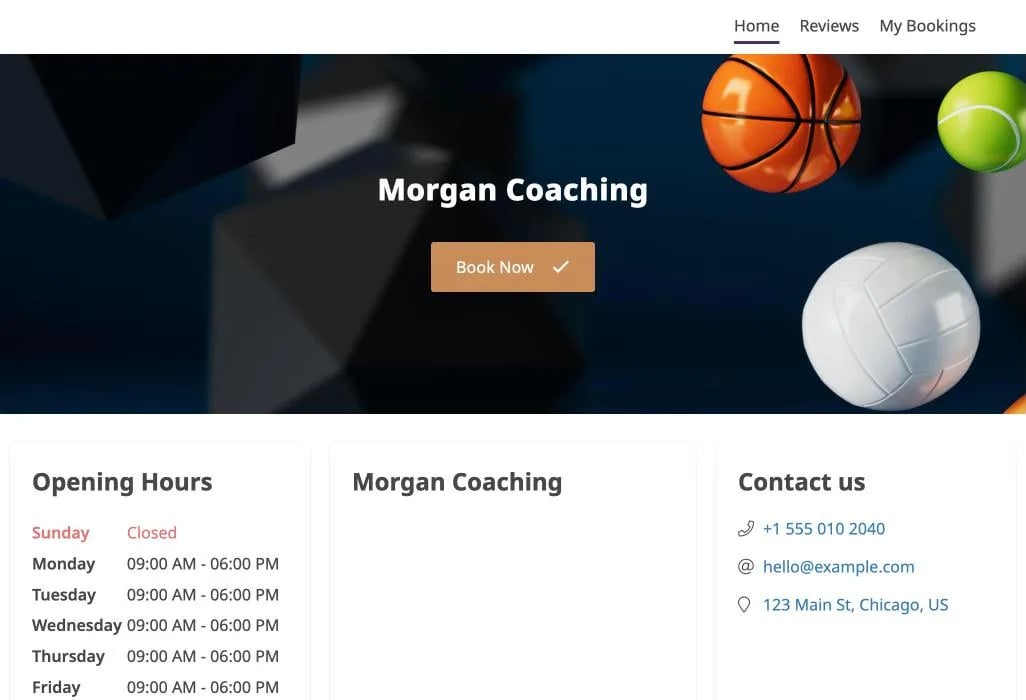
In our test: SimplyBook.me was the most frustrating app on this list. You can't even choose the free plan at first: the plan page marked it "Unavailable", with the note "It will be possible to select Free subscription 7 days before trial ends." Signing in takes 3 fields (company name, user login and password), and once you're in, the admin menu is a column of icons with no labels, so finding a setting means guessing. SimplyBook.me works, but it's hard work.
What's free
- 50 bookings a month for 1 provider.
- A booking website with opening hours, contact details and reviews, plus a booking widget.
- Email reminders.
- 1 custom feature from SimplyBook.me's add-ons.
Paid plans
Basic costs $11.90 a month billed yearly, or $13.90 billed monthly. It raises the limits to 100 bookings a month and 5 providers, and adds payments, deposits and tips, coupons and gift cards, and a client app. Standard costs $24.90 a month billed yearly, or $29.90 monthly, for 500 bookings and 15 providers.
Pros
- A full booking website on the free plan.
- Email reminders on the free plan.
- Reviews on your booking website.
Cons
- 50 bookings a month and 1 provider.
- No payments on the free plan.
- A 14-day trial before you can choose the free plan.
- An admin menu of icons with no labels.
Choose SimplyBook.me if
You run a service business with a handful of bookings a month and want a booking website without building one.
9. YouCanBook.me: best for hosts who approve each booking
YouCanBook.me turns your calendar into a booking page. Its free plan gives you 1 booking page connected to 1 calendar, with Stripe payments and a feature most free plans don't have: you can review each booking request and accept or reject it before it's confirmed.
What the free plan leaves out is reminders. Both the reminder to you and the reminder to your guest are locked, and the guest page carries a "Powered by YouCanBookMe" bar. Reminders start on Individual, at $8.10 a month billed yearly.
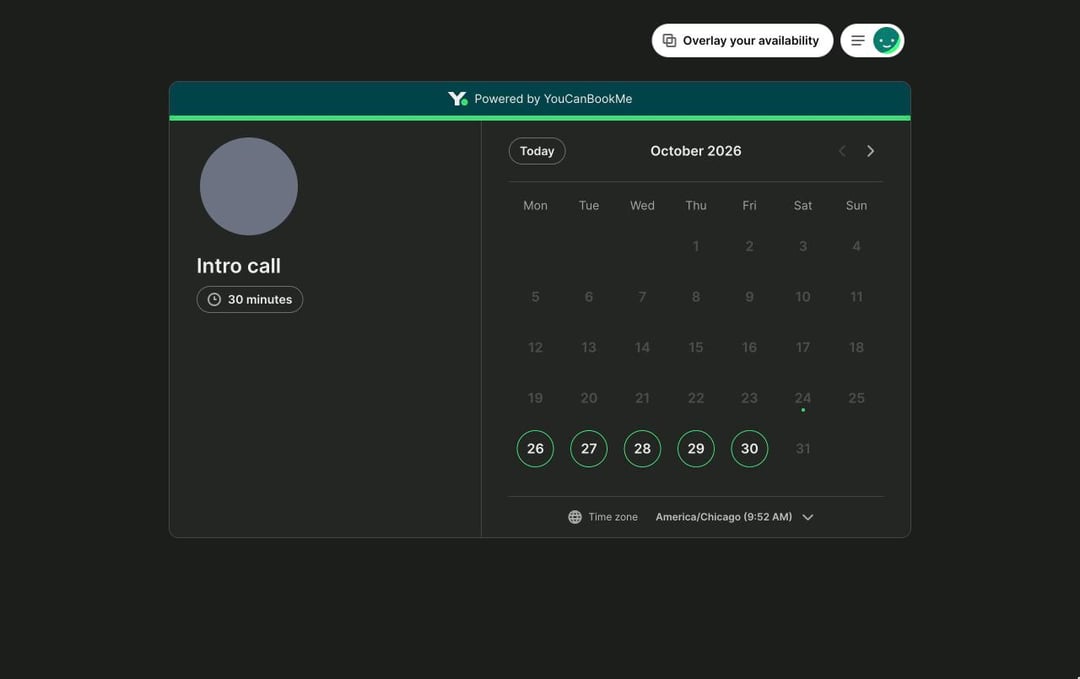
In our test: YouCanBook.me has one of the easiest editors on this list, with What, Who and When steps, a live preview and a search box for settings. The free plan is the problem. In the notification settings, "Reminder email to you" and "Reminder email to booker" both showed "Upgrade to activate this action", and a yellow warning about paid features followed us onto every screen. It feels less like a free plan and more like a nudge to upgrade.
What's free
- 1 booking page connected to 1 calendar.
- Stripe payments.
- Booking approval, so you accept or reject each request.
- Zoom, Microsoft Teams and Google Meet links.
- A booking form with up to 7 questions.
Paid plans
Individual costs $8.10 a month billed yearly, or $9 billed monthly, and adds reminder emails and texts, 2 calendars and 2 booking pages. Professional costs $11.70, or $13 monthly, and adds 6 calendars, 10 booking pages, and removes the branding. Team costs $16.20 per member, or $18 monthly, and adds round robin.
Pros
- Approve each booking before it's confirmed.
- Stripe payments on the free plan.
- A search box for settings in the editor.
Cons
- No reminders on the free plan.
- 1 booking page and 1 calendar.
- A "Powered by YouCanBookMe" bar on the guest page.
Choose YouCanBook.me if
You want to approve every booking before it goes in your calendar. To compare it with the other options, see the YouCanBook.me alternatives.
10. Doodle: best for an occasional group poll
Doodle made the group poll famous: you suggest some times, everyone ticks the ones they can make, and you pick the winner. The free plan also has a booking page and a one-on-one link.
The free plan is small, though: 1 group poll, 1 booking page and 1 one-on-one link, up to 20 times in a poll, and ads, even on your own screens. Reminders and Zoom or Teams links need Pro.
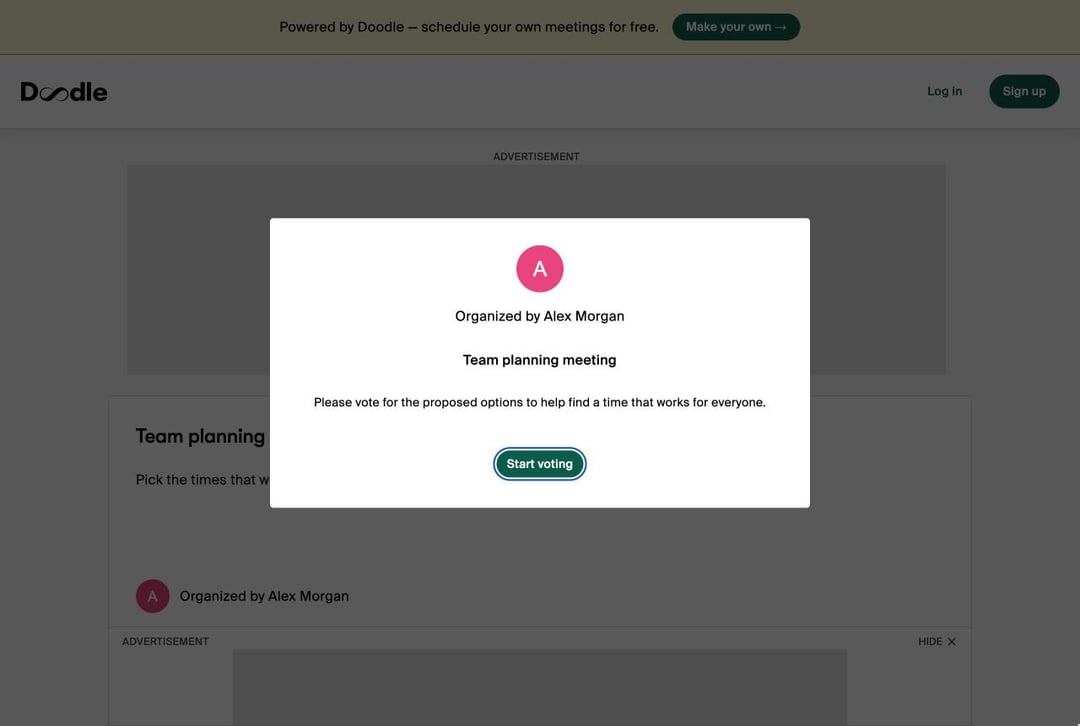
In our test: Doodle's free plan is noisy. The poll form had an ad above it and another below it, on our own screen as the host, and it capped us at "0 of 20 times selected. Upgrade to a Pro plan to select more". The dashboard pushed Pro too: "Cut no-shows by up to 30% with automatic reminders." Making a poll is still quick, but it's hard to enjoy with that much in the way.
What's free
- 1 group poll, with up to 20 times.
- 1 booking page and 1 one-on-one link.
- 3 basic sign-up sheets.
- A calendar connection to Google, Outlook or iCloud.
Paid plans
Pro costs $11 a month billed yearly, or $15 billed monthly. It removes the ads and adds unlimited polls, booking pages, one-on-ones and sign-up sheets, reminders and deadlines, your own branding, and Zoom, Microsoft Teams and Webex links.
Pros
- The group poll everyone recognizes.
- Sign-up sheets for workshops and events.
- Simple to start.
Cons
- Ads on the free plan.
- 1 group poll, 1 booking page and 1 one-on-one link.
- No reminders until Pro.
Choose Doodle if
You run one group poll now and then and don't mind the ads. For more polls, see the Doodle alternatives.
Free vs. paid: when is an upgrade worth it?
A free plan is enough as long as you take one kind of meeting from one calendar. These are the signs you've outgrown it, and the apps on this list that still cover each one for free:
- A second kind of meeting, like a 15-minute intro call next to a 60-minute session. Free on zcal and Cal.com, and on Setmore and Square, which list several services. Calendly, Google Calendar, Zoho Bookings, YouCanBook.me and Doodle stop at one.
- A second calendar, so a dentist appointment in your personal calendar blocks bookings too. Free on zcal and Cal.com. Calendly, Google Calendar, Zoho Bookings and YouCanBook.me check one calendar, and Setmore can't connect Google or Outlook at all on its free plan.
- Automatic reminders, the easiest way to cut no-shows. Free on zcal, Cal.com, Setmore, Square, Zoho Bookings and SimplyBook.me. Calendly, Google Calendar, YouCanBook.me and Doodle charge for them.
- Payments when people book. Free on zcal, Cal.com, Setmore, Square and YouCanBook.me. Calendly, Google Calendar, Zoho Bookings and SimplyBook.me charge for them.
- Group sessions such as classes and workshops. Free on zcal, with up to 5 people per time slot, and on Cal.com with seats. Calendly and Zoho Bookings charge for them.
- A team. Round robin is a paid feature on every app here. It costs $7 per user on zcal Pro, $12 on Cal.com Teams, $16 on Calendly Teams and $16.20 on YouCanBook.me Team, billed yearly.
If you're about to pay only to get a second link, a second calendar or a reminder, try a free plan that already includes them. You may not need to upgrade at all.
Which free scheduling app should you choose?
For most people, the answer is zcal. It's the only app on this list that gives you unlimited booking links and calendars, meeting polls, group events and reminders on the free plan, with a booking page that reflects your brand. When your team grows, Pro adds round robin for $7 per user.
The others make sense in narrow cases. Pick Square Appointments if your clients already pay you with a Square reader, Setmore if Setmore will be your only calendar, and Zoho Bookings if your business runs on Zoho. Choose Cal.com if you want to build detailed workflows for one person, Google Calendar if one booking page is all you'll ever need, and Doodle for one group poll now and then. We'd skip SimplyBook.me unless you really need its booking website: it was the hardest app here to set up, and you can't even pick its free plan until the trial is nearly over.
Frequently asked questions
What is the best free scheduling app?
What is scheduling software?
Is there a completely free scheduling app?
Which free scheduling app is best for small businesses?
Which app is best for group scheduling?
Is Google scheduling free?
Is Calendly still free?
Related Articles
There's a better way to schedule meetings
Join zcal freeWant unlimited booking links, polls and reminders for free?
Try zcal free